Background
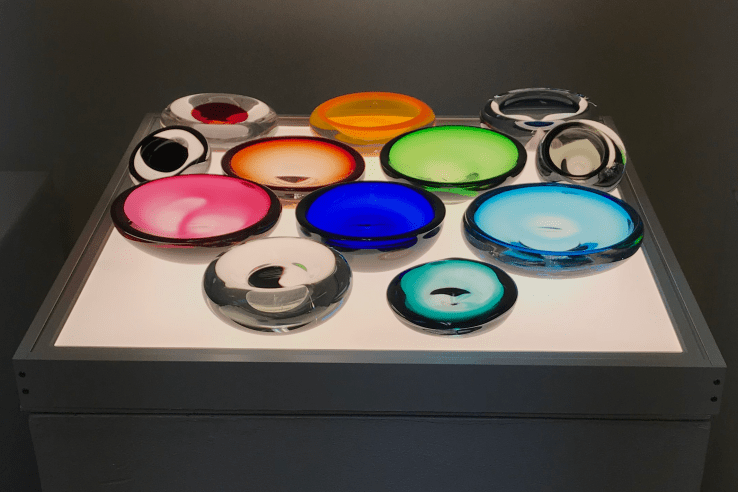
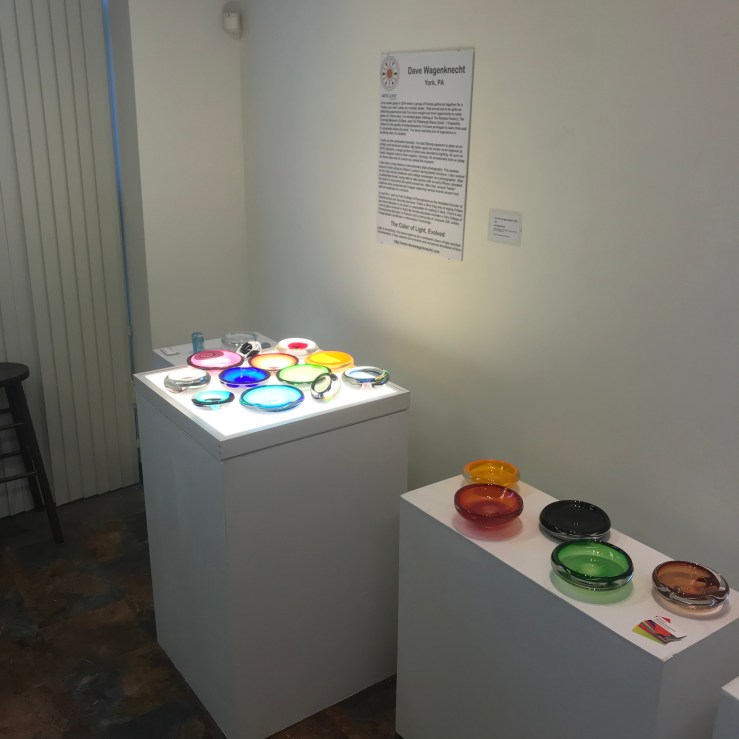
The Color of Light – Evolved is a project meant for initial display at the Banana Factory in Bethlehem, Pennsylvania. It will be shown starting July 6th, 2018.
This work shows the evolution of design, process, and skill over the several months of its creation. The bowls are displayed on a custom mounted commercially available LED lighting panel.
Design
The original intent of this project was to have overlapping bowls to create a filter effect to show the combination of colors when lit from below.
 Side view of concept
 Top view of color mixing – concept
By color theory, the colors would combine to produce the secondary colors. Blue plus green should create cyan, green plus red should create yellow, and red plus blue should create magenta. And all three should combine to produce white. (The software used to render this, misrenders this as an off grey. In retrospect, this should have been seen as an omen.) Note that these the colors are referenced to the framework of light not pigments.

Colored light mixing – (By en:User:Bb3cxv [GFDL (http://www.gnu.org/copyleft/fdl.html) or CC-BY-SA-3.0 (http://creativecommons.org/licenses/by-sa/3.0/)%5D, via Wikimedia Commons)
In practice, the colors did not combine as expected. During a recent summer intensive class, I’ve had the good fortune to consult with the Dr. Jane Cook, the Chief Scientist at the Corning Museum of Glass. She advised that the this should, of course, work. Her advice was to do more experimentation with various shades of the colors at various densities. This will be a future iteration of this project.
The final project creates the feeling of of the combined colors by featuring bowls in variants of the primary and secondary colors. It also shows the evolution and occasional devolution of techniques and tools used to create the bowls.
Process
The bowls in this project are based on a technique learned from Mark Matthews in his “Graphic and Color Systems in Glass” class. The bowls are made from several gathers of glass on a solid punty. Color is applied to the end and pressed into the gather with a stainless steel poker. After the color is applied, the gather is opened with a steam stick inserted into the channel where the color was pressed in. It is then expanded into the final form by the centrifugal force of spinning the punty in the reheating furnace and working with jacks. It is cracked off then annealed.
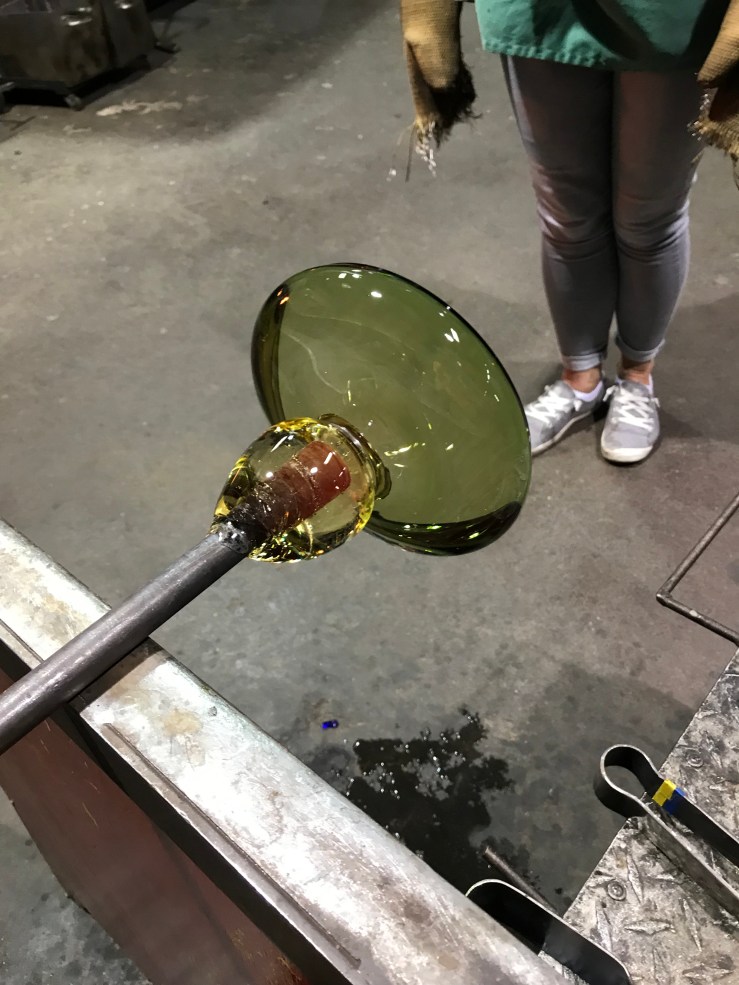 A completed bowl on the punty
The stainless steel poker to apply the color and the steam stick were custom made for the purpose. The steam stick, like shaping blocks, is made of water-soaked cherry wood.
Color Poker and Steam Stick

Color Application (lower) and Poking (upper) Visualization
Creation
Portions of this project were created at the Banana Factory, The Studio at the Corning Museum of Glass, and my home in York, Pennsylvania.
Thanks
| The following have inspired, influenced, or assisted with the project in some way. I’m grateful that they have shared their knowledge and skill. |
| Mark Matthews
Chad Balster
Mary Cash
Jane Cook |
Dennis Gardner
April Vergara
Anna Riley
Tim Spurchise |
Contact
Website: https://www.davewagenknecht.com
Email: dave@davewagenknecht.com




 Dave's Blog